Tangled Walls
Design Research Team: Maxie Schneider, Iva Resetar, Jojo Shone, Prof. Christiane Sauer
Cluster of Excellence Matters of Activity. Image Space Material, Humboldt-Universität zu Berlin
Image credit: © Jasmin Sermonet, Maja Avnat, Maxie Schneider
The research prototypes of Architectural Yarns are on display in the exhibition WEtransFORM New European Bauhaus and Beyond at the Bundeskunsthalle Bonn (6 June 2025 – 25 January 2026)
Cluster of Excellence Matters of Activity. Image Space Material, Humboldt-Universität zu Berlin
Image credit: © Jasmin Sermonet, Maja Avnat, Maxie Schneider
The research prototypes of Architectural Yarns are on display in the exhibition WEtransFORM New European Bauhaus and Beyond at the Bundeskunsthalle Bonn (6 June 2025 – 25 January 2026)
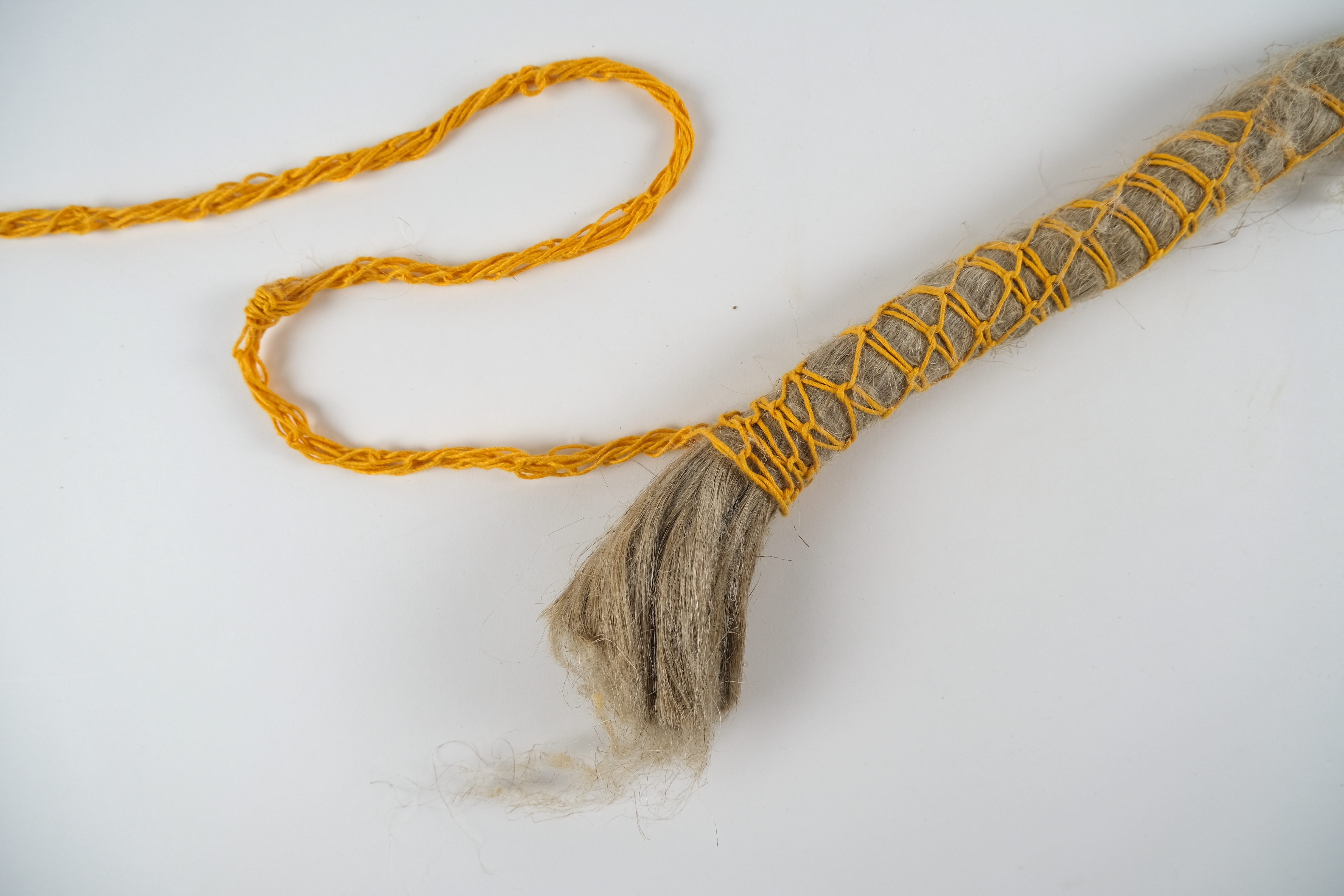
Architectural Yarns represent a textile approach to building design, one that reimagines walls not as fixed, monolithic
constructions, but as adaptable, fiber-based systems. At the heart of this
project lies a fundamental shift in how we conceive material assembly and
disassembly. Unlike additive processes such as 3D printing, which often result
in irreversible material blocks, Architectural Yarns employ a textile
logic to construct walls as continuous, linear systems, similar to knitted or
crocheted fabrics. This linearity is key: it allows for full reversibility.
Just as a sweater can be unraveled back into a single yarn, these walls can be
deconstructed to their original fiber components, preserving material integrity
and enabling true circularity.
more
more